Saturday, August 1, 2026
Column 721
The Absurdity of Banning Lawn Darts While Celebrating Holidays with Explosives
Every Independence Day, millions of Americans celebrate by setting off – or gathering to watch – explosives. It’s a tradition so familiar that few people question it. 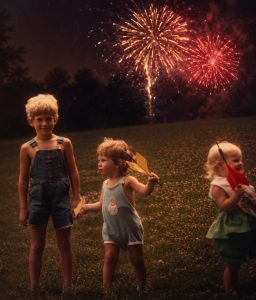 We simply accept the injuries, deaths, fires, pollution, terrified animals, sleepless neighborhoods, and enormous public expense as the unavoidable cost of a holiday.
But imagine a new consumer product introduced today with the same record. Each year it would send thousands of people to emergency rooms, kill and seriously injure users and bystanders, ignite thousands of fires, fill the air with harmful pollutants, trigger psychological distress for vulnerable people, and frighten countless domestic and wild animals. Would regulators approve it? Would lawmakers defend it? Or would it be recalled, restricted, or banned?
Fireworks remain legal not because they are safe, but because they are traditional. Tradition, however, has never been a convincing defense for preventable harm.
The Human Cost
The dangers of fireworks are neither rare nor unpredictable. During the 2025 Independence Day fireworks season, the U.S. Consumer Product Safety Commission (CPSC) estimated that fireworks were associated with approximately 13,000 emergency department-treated injuries and 15 deaths. Nearly one-third of those injured were under the age of 20. Burns accounted for about 37 percent of all injuries, with hands, fingers, faces, eyes, and heads among the body parts most frequently damaged.
Even sparklers – often handed to young children – burn at roughly 2,000 degrees Fahrenheit (1,093°C), hot enough to melt some metals. The CPSC estimated that sparklers alone were responsible for approximately 1,300 injuries during the 2025 season. These are not freak accidents. Emergency physicians expect them. Burn centers prepare for them. Fire departments plan for them.
And yet, every year, we treat the resulting injuries as though they are simply part of celebrating a national holiday. They shouldn’t be.
The Fires We Choose to Start
Explosives are designed to explode. It should surprise no one that they also ignite homes, vehicles, forests, and neighborhoods. According to the National Fire Protection Association, fireworks caused 32,302 fires in the United States during 2023, including 3,760 structure fires, 849 vehicle fires, and 27,252 outside and vegetation fires. Those fires resulted in 15 civilian deaths, 58 civilian injuries, and an estimated $142 million in direct property damage.
Those numbers capture only the immediate losses. They do not include the costs of emergency medical care, overtime for firefighters and police officers, cleanup, insurance investigations, temporary housing for displaced families, or the emotional toll on people who lose homes, treasured possessions, pets, or loved ones. For a form of entertainment that lasts only a few minutes, the consequences can last a lifetime.
The Silent Victims
For many people, the celebration ends when the last shell explodes. For animals, it often begins there.
Anyone who has lived with a dog or cat has seen the panic fireworks can cause. Dogs tremble uncontrollably, pace, pant, drool, or desperately search for somewhere – anywhere – to hide. 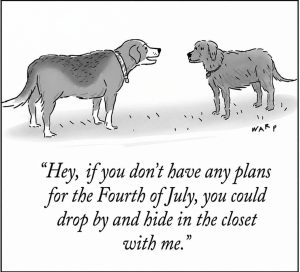 Cats wedge themselves into impossibly small spaces or bolt through open doors and windows. Some animals refuse to eat for days. Others jump fences, chew through doors, or run blindly into traffic trying to escape what they perceive as a life-threatening danger.
Many animal shelters report that the days surrounding Independence Day are among their busiest of the year for stray admissions as frightened pets flee homes and yards. While many are eventually reunited with their families, some never make it home.
The impact extends far beyond our companion animals. Wildlife has no warning that the deafening explosions are coming. Using weather radar, scientists have documented that fireworks can send hundreds of thousands of birds into sudden nighttime flight. Startled from their roosts, they burn valuable energy reserves, collide with buildings, power lines, and other obstacles, and abandon areas they had considered safe only moments before. Researchers have also found that fireworks disturb birds many miles from the launch sites, demonstrating that the effects extend well beyond the immediate display.
Because these events occur under the cover of darkness and away from public view, much of the suffering goes unnoticed. If similar fear were deliberately inflicted on domestic animals, there would be widespread public outrage. When the victims are wildlife, we scarcely acknowledge it.
The Psychological Casualties
For countless military veterans, fireworks are anything but festive. The U.S. Department of Veterans Affairs recognizes that sudden explosions, bright flashes, and concussive blasts can trigger symptoms associated with post-traumatic stress disorder, including anxiety, panic, hypervigilance, insomnia, and traumatic memories.
Fireworks can also be overwhelming for many autistic individuals, people living with dementia, young children with sensory sensitivities, and others for whom unexpected explosive noise is far more than a temporary annoyance. The common response is, “It’s only one night.” But anyone who has lived in a community where consumer fireworks are legal knows that isn’t true. The explosions often begin days – or even weeks – before Independence Day and continue long after the holiday has passed. For many families, there is simply no escape.
Poisoning the Air
The damage does not end when the smoke drifts away. Fireworks release fine particulate matter (PM2.5), sulfur compounds, perchlorates, and metals such as barium, copper, strontium, and aluminum – the chemicals responsible for producing their brilliant colors.
Air-quality monitors routinely record dramatic spikes in pollution following major fireworks displays. One nationwide study found that average PM2.5 concentrations increased by 42 percent in the hours following Independence Day fireworks, with even higher levels measured immediately downwind of large displays.
These microscopic particles are small enough to penetrate deep into the lungs and enter the bloodstream. They are associated with aggravated asthma, respiratory illness, cardiovascular problems, and other serious health risks, particularly for children, older adults, and people with existing heart or lung disease.
The colorful smoke may disappear quickly from view, but the pollutants remain in the air and eventually settle into our parks, neighborhoods, lakes, and rivers. Once again, the costs are shared by everyone, including those who never chose to participate in the celebration.
Billions Going Up in Smoke
The financial cost of fireworks is almost as difficult to justify as the human cost. Americans spent an estimated $2.2 billion on consumer fireworks in 2024, according to the American Pyrotechnics Association. Professional displays added hundreds of millions of dollars more. That is only the purchase price.
It does not include the costs of police and fire protection, emergency medical services, cleanup, insurance claims, property losses, environmental impacts, or lost productivity. Imagine if even a portion of that money were redirected toward causes that genuinely improve lives: animal shelters, veterans’ mental health services, children’s hospitals, wildfire prevention, public libraries, medical research, scholarships, affordable housing, food banks.
Instead, we spend billions on explosions that disappear in minutes while leaving behind injuries, pollution, frightened animals, and damaged property. Few consumer products deliver so much harm for so little lasting benefit.
“Professional Displays Are Different”
Professional fireworks displays are undoubtedly safer than backyard pyrotechnics. But they are not harmless. The explosions are louder. The shells are larger. The concussion travels farther.
Dogs do not know whether the explosion came from a licensed pyrotechnician or a neighbor down the street. Birds do not know. Veterans do not know. Wildlife does not know.
Professional displays reduce the risk of mishandling explosives. They do not eliminate the explosions themselves. That is the problem.
The Lawn Dart Test
Perhaps the clearest measure of our inconsistency is found in a game that virtually disappeared from American backyards nearly four decades ago: lawn darts.
Between 1978 and 1987, the U.S. Consumer Product Safety Commission estimated that lawn darts were responsible for approximately 6,100 emergency department-treated injuries. More than three-quarters of those injured were children under the age of 15, about half were younger than 10, and more than half of all injuries involved the head, face, eyes, or ears. Approximately 25 people each year required hospitalization. Federal regulators also confirmed three child deaths, all caused by penetrating head injuries.
The government first tried warning labels, age restrictions, and limiting sales to adults. None of it worked. Children still gained access to lawn darts. In 1988, the Consumer Product Safety Commission concluded that the risk could not be adequately controlled and prohibited the sale of pointed lawn darts throughout the United States.
Now consider fireworks.
In one holiday season, fireworks produce roughly twice as many emergency-room injuries as lawn darts did over nearly a decade. They are associated with thousands of hospital visits, multiple deaths, tens of thousands of fires, millions of dollars in property damage, widespread air pollution, psychological trauma for many veterans and others, and fear and suffering for countless domestic and wild animals. Yet they remain legal.
If lawn darts failed the test of reasonable public safety, how can fireworks possibly pass it?
We Have Better Ways to Celebrate
Communities around the world are already demonstrating that there are better alternatives: drone light shows, laser displays, architectural lighting, concerts, community festivals. These events create lasting memories without filling emergency rooms, polluting the air, or terrifying animals. Technology has given us the ability to celebrate without explosions. The only question is whether we are willing to embrace it.
Time for Leadership
America has repeatedly chosen to regulate products once the evidence showed that the harm outweighed the benefit: leaded gasoline, asbestos, unsafe toys, smoking in many public places – and, yes (absurd by comparison), lawn darts. Each was defended at one time as normal, acceptable, or simply part of everyday life. Each was eventually judged by the evidence rather than by tradition. Fireworks deserve that same re-evaluation.
Congress should prohibit the manufacture, importation, and interstate sale of consumer fireworks. States should end their retail sale and private use. Communities should replace explosive displays with quieter, safer alternatives that celebrate without leaving a trail of injuries, fires, pollution, and fear.
Fireworks are not a necessity. They are a choice. Every year that choice leaves thousands injured, homes destroyed, animals terrified, veterans retraumatized, wildlife displaced, and our air more polluted. The question is no longer whether we can celebrate without explosives. The question is why we continue to defend a product that would almost certainly never be approved if it were introduced today.
If lawn darts were judged too dangerous to remain on the market, then fireworks deserve the same honest, evidence-based scrutiny.
Stay thirsty, my friends,
Dartoid